
GEODI Discovery Series | Issue 08 | Not All Data Is Equal
Updated: Sep 29
Not All Data Is Equal
Executive Summary
Organizations store millions of documents. Yet not every document has the same business value, level of risk, or need for protection. Data classification makes it possible to manage information according to its value rather than merely storing it.
This enables organizations to prioritize security investments more accurately, accelerate compliance processes, and protect critical information more effectively.
Why Is Classification Necessary?
Imagine a company.
On the same file server:
· Marketing presentations,
· Human resources records,
· Financial statements,
· Source code,
· Board resolutions,
· Customer contracts
are stored side by side.
Technically, they may all be "files."
From a business perspective, however, they do not all have the same value.
If one falls into the wrong hands, it may cause only a minor inconvenience; another could lead to millions in financial losses and reputational damage.
This is where one of the fundamental questions of data security begins:
Which information is truly critical?
Is the Same Level of Protection Right for All Data?
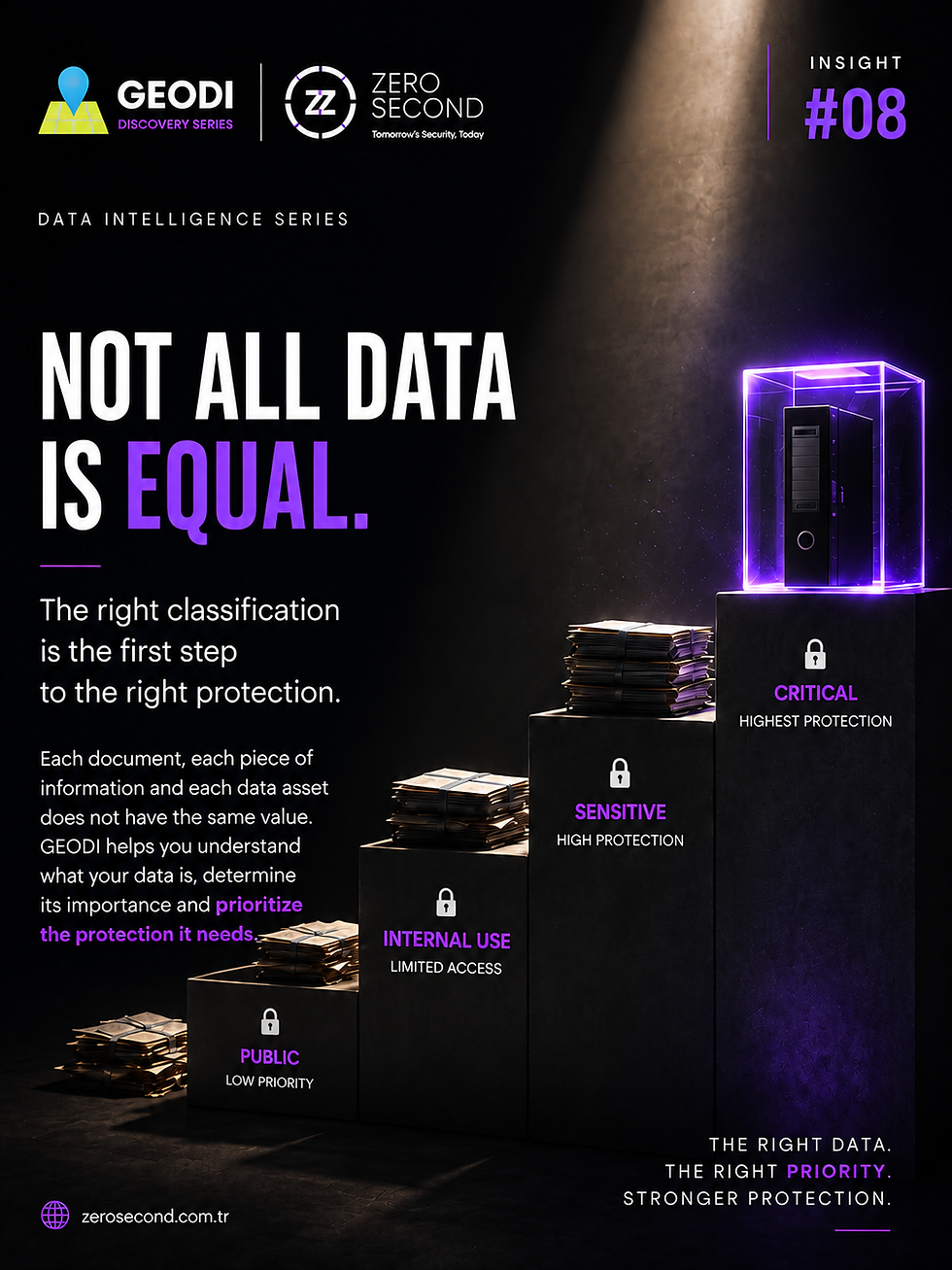
In the past, many organizations tried to protect all data using the same security policies.
This approach created an operational burden and made it difficult to prioritize truly critical information.
Because security is not merely about restricting access.
It is about applying the right protection to the right information.
To do this, you must first understand what the data is.
What Does Data Classification Change?
Data classification evaluates documents not only by file type, but also by:
· The information they contain,
· Their level of sensitivity,
· Their regulatory scope,
· Their business value and intended use.
This enables organizations to automatically distinguish:
· Personal data,
· Trade secrets,
· Financial records,
· Intellectual property assets,
· Critical operational information.
Benefits for Business Processes
Properly classified data:
· Enables security policies to be applied more accurately.
· Simplifies KVKK and GDPR audits.
· Makes DLP and data protection solutions more effective.
· Reduces unnecessary security costs.
· Enables risk-based data management.
The GEODI Perspective
With its advanced content analysis and semantic capabilities, GEODI does more than index documents; it evaluates their content and can automatically classify the data.
This means organizations do more than simply possess data.
They also know which data truly matters.
Key Takeaway
The first step in data security is not protecting all data, but knowing which data needs to be protected.
GEODI Discovery Series
Prepared by Zero Second
Helping organizations discover, understand and protect their most valuable asset: data


Comments